





ORGANS OF PARIS © 2026 Vincent Hildebrandt HOME ALL ORGANS


E3
The Salle de la Coupole houses an organ built by Cavaillé-
Coll-Pleyel in 1936, based on a design drawn up by the
organist Marcel Dupré. The instrument is made up of two
chambers located high up in the left and right lateral
apses. Only the shutters (swell louvers) of the two
expression boxes, visible on the façade, blend into the
wall through their color (see photo).
In 1979, the organ builder Jacques Barberis carried out a
complete overhaul and improved the voicing.
In 1991, at the request of its Titular organist, the organ
was further improved by the builder Bernard Dargassies.
Several stops were modified or reworked at that time.
The organ has two manuals and pedalboard, fully electric
action, and a console hidden at the back of the right
apse. It has 21 stops, of which 17 are real. No pipework is
visible; instead, there are two expression boxes on either
side of the choir — the Grand Orgue on the left and the
Récit on the right (console side).
(Translation of a French text by Thierry Correard).



The Salle de la Coupole of the Père-Lachaise
crematorium, built at the end of the 19th century, is
listed as a Historic Monument. This entirely secular
complex consists of a hall (with a dome) that can serve
as a ceremonial space, along with four wings forming
the columbarium where funeral urns are placed.
The building housing the ceremony hall is in Neo-
Byzantine style. Its nave has a square plan and is
topped by a large dome forming a cupola, pierced by
eight arched openings. Beautiful non-figurative
stained-glass windows diffuse a soft, calming light.
The hall includes three raised apses — one central and
two lateral. A mosaic covers the central apse, depicting
an imaginary landscape beneath a starry sky.
(Translation of a French text by Thierry Correard).
1936 - Cavaillé-Coll-Pleyel (1)
1960 - Chéron (7)
1979 - Barbéris (3)
1991 - Dargassies (3)
II/21 (17) - Electrical traction
stoplist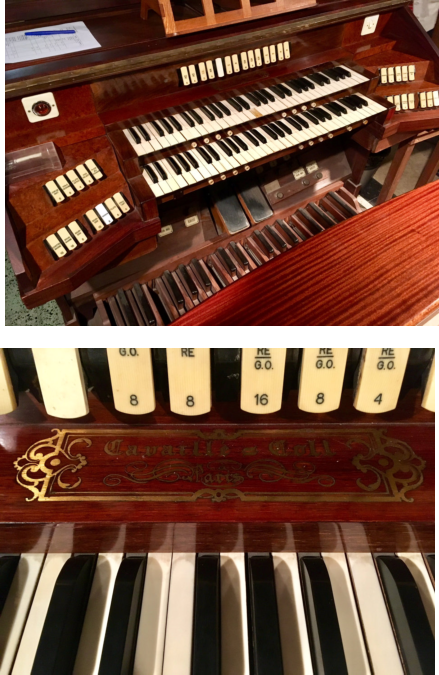








Organs of Paris


ORGANS OF PARIS © 2026 Vincent Hildebrandt


E3
The Salle de la Coupole houses an organ built by Cavaillé-
Coll-Pleyel in 1936, based on a design drawn up by the
organist Marcel Dupré. The instrument is made up of two
chambers located high up in the left and right lateral
apses. Only the shutters (swell louvers) of the two
expression boxes, visible on the façade, blend into the
wall through their color (see photo).
In 1979, the organ builder Jacques Barberis carried out a
complete overhaul and improved the voicing.
In 1991, at the request of its Titular organist, the organ
was further improved by the builder Bernard Dargassies.
Several stops were modified or reworked at that time.
The organ has two manuals and pedalboard, fully electric
action, and a console hidden at the back of the right
apse. It has 21 stops, of which 17 are real. No pipework is
visible; instead, there are two expression boxes on either
side of the choir — the Grand Orgue on the left and the
Récit on the right (console side).
(Translation of a French text by Thierry Correard).
1936 - Cavaillé-Coll-Pleyel (1)
1960 - Chéron (7)
1979 - Barbéris (3)
1991 - Dargassies (3)
II/21 (17) - Electrical traction
stoplist
