



ORGANS OF PARIS © 2026 Vincent Hildebrandt HOME ALL ORGANS


Conservatoire National Supérieur
de Musique et de Danse de Paris
209, avenue Jean-Jaurés, 75019 ParisSalle Nadia Boulanger/Orgue Italien
Salle Nadia Boulanger/Orgue Rieger>
Study organs>

1702
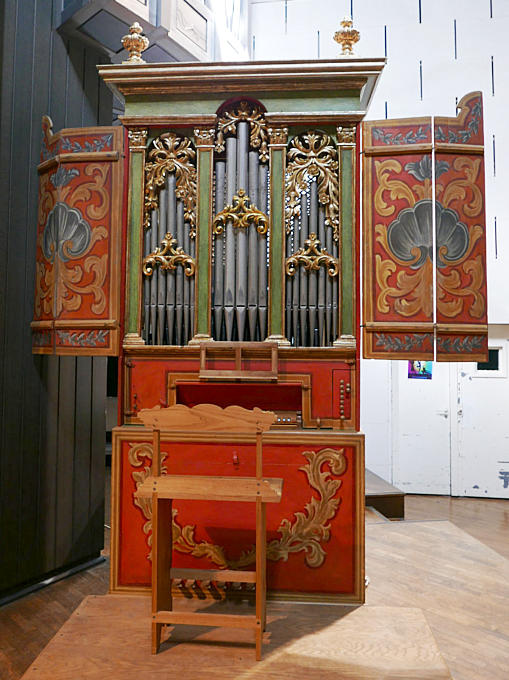
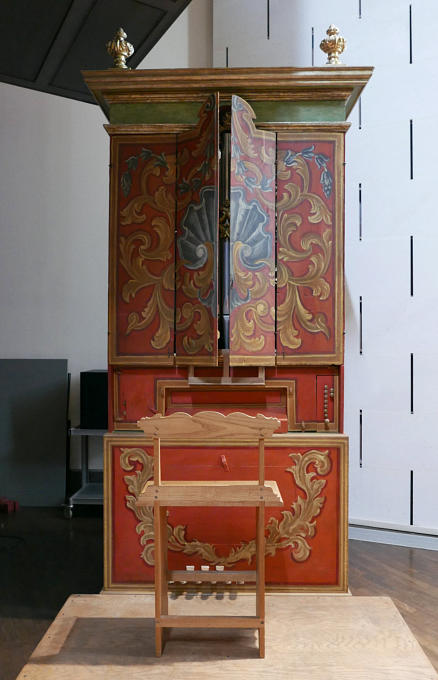
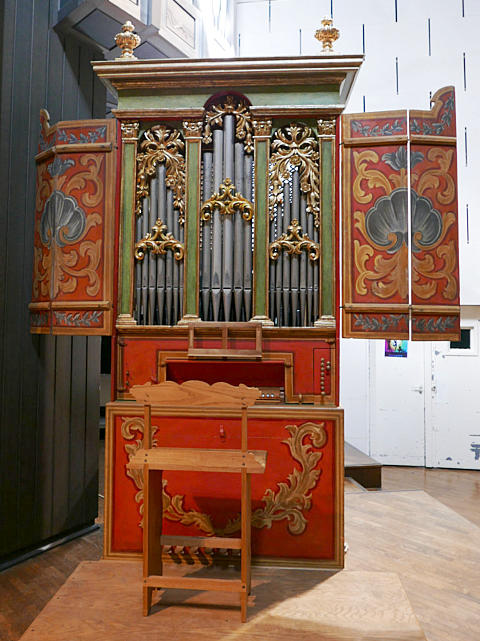
A small Italian Positivo organ from the early 18th century,
attributed to the Baffi and Cimino workshop. The case is
decorated with a rich ornamental design. Entirely painted on
a red ground, with floral motifs on the doors, it is topped by
two finials. The three flat façades forming the front are
enhanced with gilded sculptures, as is often seen on Italian
Baroque organs.
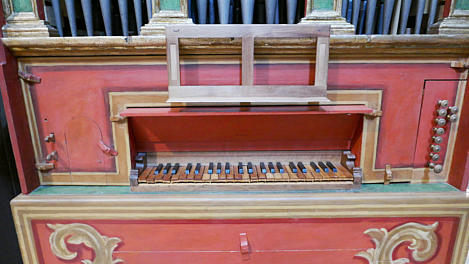
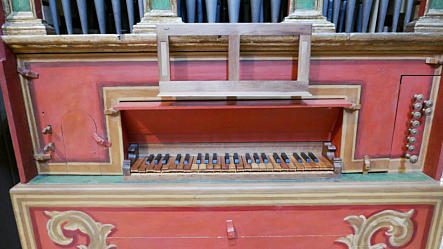
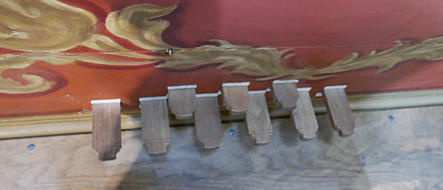
The console has a single 45‑note keyboard. The Italian
pedalboard, an octave short, is coupled to the keyboard by a
simple string mechanism.
The stops are arranged on the side, with no labels to identify
them. In fact, this is a typical Italian ripieno, so the stop layout
is simple. On the first column the ranks are arranged from the
lowest to the highest pitch, with one larger pull at the bottom
that activates all the others. On the second column there is a
Voce umana and a 2' 2/3 stopped flute.
On the left, a small opening with a shutter contains a
nightingale (rossignol), and two notched wooden levers
operate the bourdons (two reed pipes, C and F).
•
Principale 8
•
Ottava 4
•
Decima nona (1 1/3)
•
Quintadecima (2)
•
Vigesima sesta (2/3)
•
Vigesima nona (1/2)
•
Vigesima seconda (1')
•
Voce Umana (8)
•
Flauto in duodecima
Deux yeux (ré & la) "faux bourdon".
Tempérament mésotonique.
2012
Relocation and restoration by Michel Formentelli.








Organs of Paris


ORGANS OF PARIS © 2026 Vincent Hildebrandt
Conservatoire National
Supérieur de Musique
et de Danse de Paris
209, avenue Jean-Jaurés, 75019 ParisSalle Nadia Boulanger/Orgue Italien
Salle Nadia Boulanger/Orgue Rieger>
Study organs>
1702
A small Italian Positivo organ from the early 18th century,
attributed to the Baffi and Cimino workshop. The case is
decorated with a rich ornamental design. Entirely painted on
a red ground, with floral motifs on the doors, it is topped by
two finials. The three flat façades forming the front are
enhanced with gilded sculptures, as is often seen on Italian
Baroque organs.
The console has a single 45‑note keyboard. The Italian
pedalboard, an octave short, is coupled to the keyboard by a
simple string mechanism.
The stops are arranged on the side, with no labels to identify
them. In fact, this is a typical Italian ripieno, so the stop layout
is simple. On the first column the ranks are arranged from the
lowest to the highest pitch, with one larger pull at the bottom
that activates all the others. On the second column there is a
Voce umana and a 2' 2/3 stopped flute.
On the left, a small opening with a shutter contains a
nightingale (rossignol), and two notched wooden levers
operate the bourdons (two reed pipes, C and F).
•
Principale 8
•
Ottava 4
•
Decima nona (1 1/3)
•
Quintadecima (2)
•
Vigesima sesta (2/3)
•
Vigesima nona (1/2)
•
Vigesima seconda (1')
•
Voce Umana (8)
•
Flauto in duodecima
Deux yeux (ré & la) "faux bourdon".
Tempérament mésotonique.
2012
Relocation and restoration by Michel Formentelli.